Knowing how to reconstitute peptides correctly is the foundation of reliable laboratory work. Most research peptides arrive as a dry crystalline powder sealed in a vial, and before they can be measured or used in an experiment they have to be dissolved in a suitable liquid to give a solution of known concentration. Get the volume or the technique wrong and every measurement that follows is wrong too.
This guide explains how to reconstitute peptides step by step: the equipment you need, how to work out the concentration before you start, a simple seven-step method, and the most common mistakes to avoid. It is written for in-vitro research only: Trident Peptides products are not for human consumption, and nothing here is medical or dosing advice.
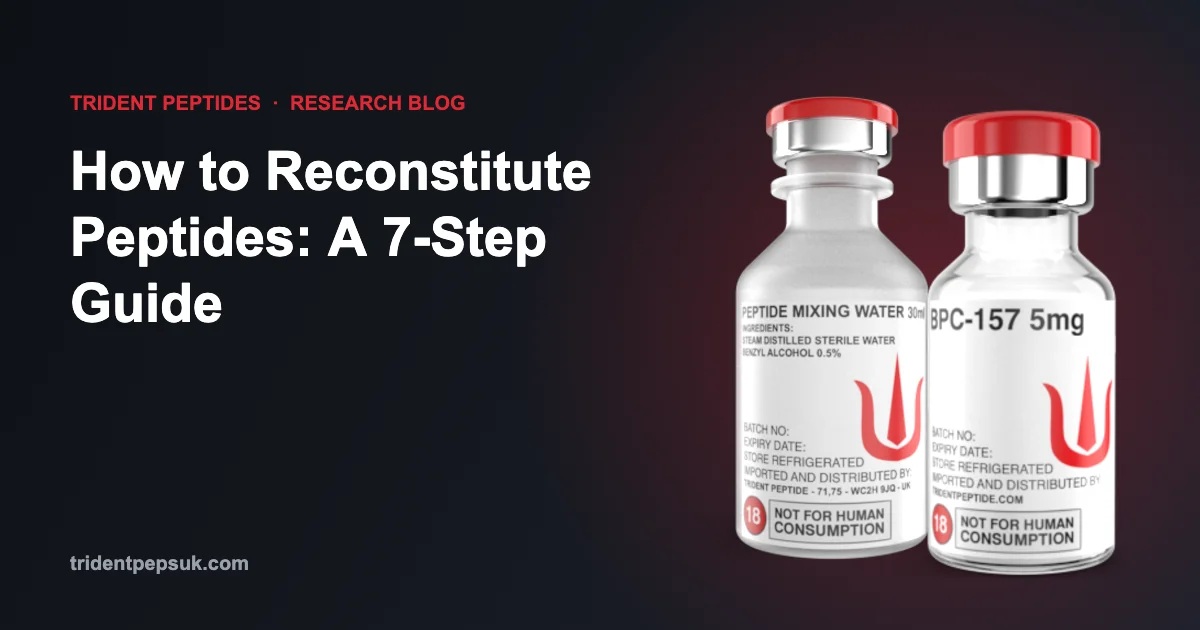
What you need before you reconstitute peptides
- The peptide vial, at room temperature (see step 1 below).
- A suitable solvent. For most water-soluble research peptides this is bacteriostatic water, such as our peptide mixing water 10ml or 30ml.
- An accurate measuring tool, for example a 1ml measuring syringe.
- 70% isopropyl alcohol swabs to clean the vial stoppers.
- A clean, uncluttered work surface, disposable gloves and a sharps container.
- A label and a pen, so the vial can be marked as soon as it is mixed.
How to calculate peptide concentration
Decide on the volume of water before you open anything. The concentration of the finished solution is simply the amount of peptide divided by the volume of liquid:
Concentration (mg per ml) = peptide in the vial (mg) ÷ water added (ml)
Remember that 1mg = 1000mcg, so 0.1ml of a 2.5mg/ml solution contains 250mcg.
For example, a 5mg vial of BPC-157 reconstituted with 2ml of water gives 2.5mg per ml, which is 250mcg in every 0.1ml. Add only 1ml and the same vial gives 500mcg per 0.1ml. The table below shows common combinations.
| Peptide in vial | 1ml water | 2ml water | 3ml water |
|---|---|---|---|
| 2mg | 200mcg per 0.1ml | 100mcg per 0.1ml | about 67mcg per 0.1ml |
| 5mg | 500mcg per 0.1ml | 250mcg per 0.1ml | about 167mcg per 0.1ml |
| 10mg | 1000mcg per 0.1ml | 500mcg per 0.1ml | about 333mcg per 0.1ml |
Larger volumes make each measurement smaller and easier to divide accurately, but they also fill more of the vial. Every Trident Peptides product page includes its own reconstitution reference, so check it before choosing a volume.
How to reconstitute peptides in 7 steps
- Let the vial reach room temperature. Taking a cold vial straight from the freezer and opening it can let moisture condense on the powder. Leave it sealed on the bench for 15 to 30 minutes first.
- Clean both stoppers. Wipe the rubber top of the peptide vial and the water container with an alcohol swab and let them air-dry.
- Measure the water. Draw up exactly the volume you planned. Check the reading at eye level and remove any air bubbles.
- Add the water slowly down the side of the vial. Aim the stream at the inside wall of the glass rather than directly at the powder. This reduces foaming and helps the powder dissolve evenly.
- Swirl gently – do not shake. Roll the vial between your fingers or swirl it slowly. Vigorous shaking can cause foaming and may encourage some peptides to aggregate. Give it a few minutes; most peptides dissolve quickly, but some take longer.
- Inspect the solution. Most solutions are clear. Some products are normally cloudy or coloured: GHK-Cu is blue, KLOW is purple, and TB-500, BPC-157 and HGH Fragment 176-191 can look cloudy. The product page tells you what to expect.
- Label and refrigerate. Write the compound, the concentration and the date on the vial, then store it in the fridge at 2–8°C.
Special cases to know about
When you are working out how to reconstitute peptides from our range, a few compounds need extra care:
- HGH Fragment 176-191 needs at least 3ml of water. Smaller volumes can make the solution solidify, and sodium chloride (saline) water can cause the same problem, so use bacteriostatic water only.
- NAD+ 1000mg needs 10ml of water and a gentle shake. If crystals remain after 60 minutes, the solution can be warmed to 40°C and then left to cool. Once mixed it has a maximum shelf life of 56 days.
- Blends such as KLOW and each vial in the BPC-157 TB-500 combo use 3ml of water.
Storing peptides after reconstitution
Once a peptide is in solution it is much less stable than the dry powder. Keep reconstituted vials refrigerated, protect them from light and never freeze them, because freezing and thawing can damage the peptide. Bacteriostatic water contains benzyl alcohol, a preservative that helps protect the solution during repeated withdrawals. For a fuller explanation, read our guide on how to store peptides.
Common reconstitution mistakes
- Not deciding the water volume in advance, so the final concentration is unknown.
- Squirting water directly onto the powder and shaking hard.
- Using the wrong liquid, such as saline for a compound that should not be mixed with sodium chloride.
- Forgetting to label the vial with the date and concentration.
- Leaving the solution at room temperature or in sunlight.
Summary
Knowing how to reconstitute peptides accurately comes down to a few habits: plan the volume first, work cleanly, add the water slowly, swirl rather than shake, and label and refrigerate the vial straight away. If you have questions about a specific product, the reconstitution table on its page is the best starting point, or you can contact our team. You can browse our full range of research peptides and bacteriostatic water in the shop.