What are research peptides, and how are they different from the proteins and medicines people read about? In simple terms, research peptides are short chains of amino acids that are made synthetically and supplied to laboratories for scientific study. They are labelled for research use only, which means they are intended for in-vitro experiments and not for use in or on people or animals.
This guide covers peptide structure, how synthetic peptides are made, the chemical modifications you will see in product names, and what “research use only” means in practice.
What are research peptides made of?
Every peptide is built from amino acids joined end to end by peptide bonds (amide bonds formed between the carboxyl group of one amino acid and the amino group of the next). The order of the amino acids, called the sequence, determines the peptide’s shape and behaviour.
- Size: by a common convention, chains of up to about 50 amino acids are called peptides and longer chains are called proteins, although the boundary is not strict.
- Examples from our range: Epitalon is a tetrapeptide of just four amino acids, BPC-157 has 15, and IGF-1 LR3 has 83, which puts it closer to a small protein.
How synthetic peptides are made
Most research peptides are produced by solid-phase peptide synthesis, a method developed by Robert Bruce Merrifield, who received the 1984 Nobel Prize in Chemistry for it. The process works in four broad stages:
- The first amino acid is anchored to tiny insoluble resin beads.
- Amino acids are added one at a time, using temporary protecting groups so that each one attaches only at the right point.
- The finished chain is cut free from the resin and the protecting groups are removed.
- The crude peptide is purified, usually by HPLC, and then freeze-dried into a stable powder.
Purification and quality testing are covered in more detail in our guide to peptide purity.
Common modifications in research peptide names
Many research peptides are deliberately modified to change their stability or behaviour. The product name often tells you which modification has been made:
| Modification | What it means | Example |
|---|---|---|
| Cyclisation | The chain is joined into a ring, which can make it more rigid and stable | PT-141 |
| PEGylation | Polyethylene glycol chains are attached to increase stability | PEG MGF |
| D-retro-inverso | Built from D-amino acids in reversed order to resist enzymes | FOXO4-DRI |
| Drug Affinity Complex (DAC) | An albumin-binding group that extends half-life in research models | CJC-1295 DAC |
| Metal complex | The peptide is bound to a metal ion | GHK-Cu (copper) |
What does “research use only” mean?
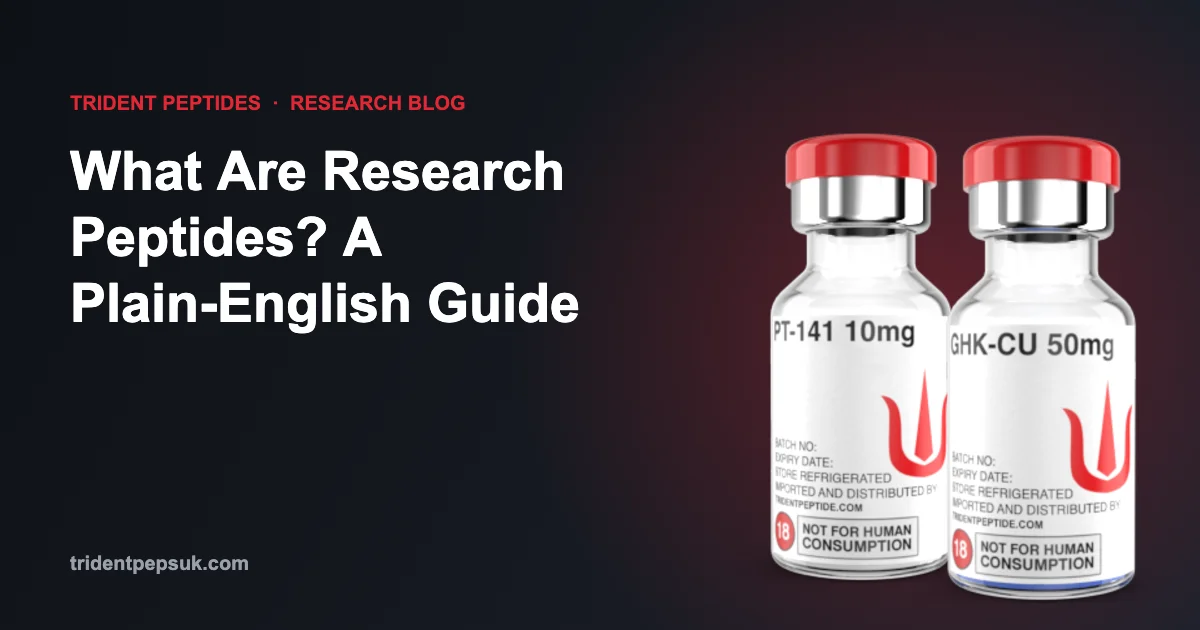
A research use only (RUO) label tells you the product is supplied for laboratory investigation. It is not a medicine, a food supplement or a cosmetic; it has not been evaluated or authorised for treating, preventing or diagnosing any condition; and it is not for human or veterinary use. Every Trident Peptides product carries this status, our vials are marked “not for human consumption”, and buyers must be 18 or over.
How to choose research peptides from a supplier
- Check that each product lists its quantity, stated purity and CAS number where one exists.
- Look for clear storage and reconstitution information on the product page.
- Make sure you also have suitable bacteriostatic water and measuring equipment.
- Ask the supplier any questions before ordering.
Summary
So, what are research peptides? They are synthetic amino-acid chains, typically made by solid-phase synthesis, purified, freeze-dried and supplied for laboratory study only. Understanding their structure and modifications makes product information much easier to read. Browse our research peptides UK range, or start with our guide on how to reconstitute peptides.